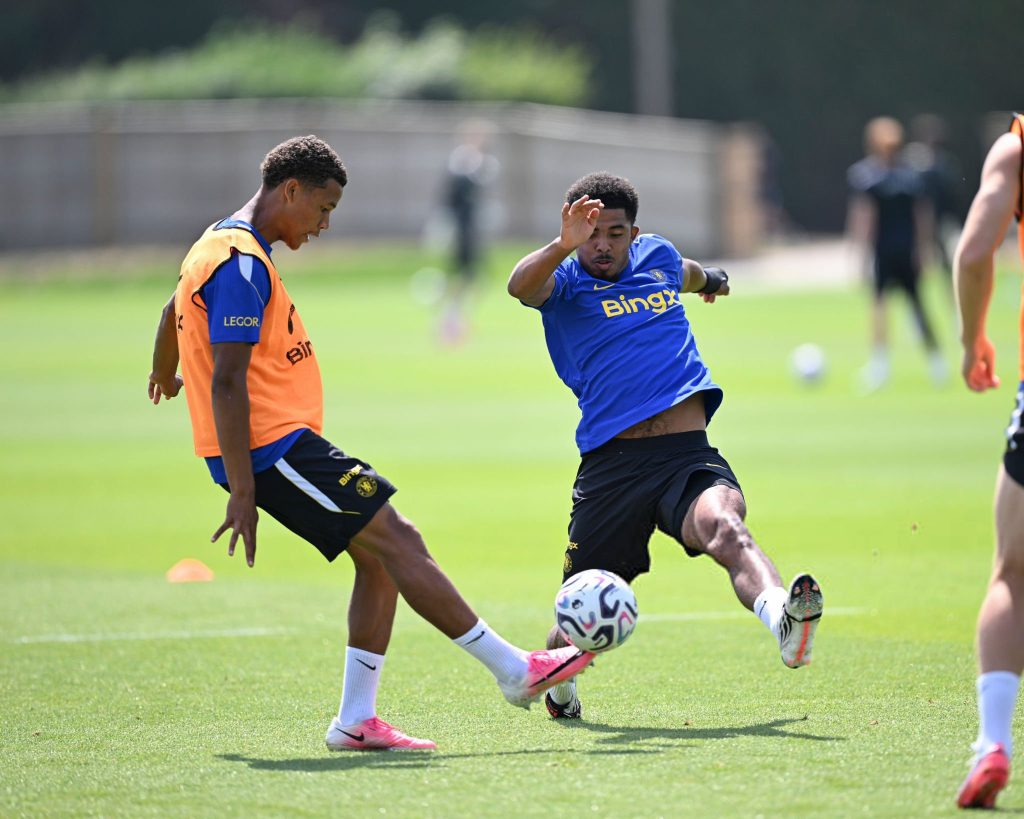
Mahdi Nicoll-Jazuli is being talked about inside Chelsea’s academy as one of the most complete midfield prospects the club has produced in years, and it took senior pre-season minutes against Juventus and Tottenham Hotspur for that reputation to start spreading beyond Cobham.
At 16, and not due to turn 17 until January, Nicoll-Jazuli was given 66 minutes against Juventus this pre-season, lining up opposite senior professionals including Manuel Locatelli and Douglas Luiz.
Xabi Alonso addressed it directly afterwards, saying he does not even remember who he was playing against himself at 16, let alone opposition of that calibre.
He also featured against Tottenham Hotspur, where a composed defensive moment out wide gave scouts a second, different look at how he reads the game.
That the head coach felt moved to comment publicly on a 16-year-old’s positioning inside a pre-season friendly is, on its own, a signal of how highly he is rated internally.
This report exists because those appearances offered the first real data points on a player previously known mostly through academy reputation and comparisons.
Between the underlying numbers from the Juventus game, independent scouting observations of his movement and decision-making, and Alonso’s own assessment of what he still has to learn, there is now enough to properly assess what kind of midfielder Chelsea are developing, and where his ceiling might sit.
For his full background and academy journey, see our Mahdi Nicoll-Jazuli player profile.

Mahdi Nicoll-Jazuli’s Style of Play
Nicoll-Jazuli was not developed as a central midfielder from the start.
He came through Chelsea’s academy as a centre-back, and it was only as his passing range and game understanding became clear that he was moved into midfield, where he has since established himself as comfortable in three distinct roles: the No. 6, the No. 8 and the No. 10.
That defensive background is the single most useful lens for understanding how he plays now.
His reading of the game, his timing when stepping into duels and his habit of sensing danger before it fully develops are not generic midfield traits, they are a converted defender’s instincts applied one line further up the pitch.
In possession, the picture is of a midfielder who prioritises control over spectacle.
Scouting notes from his Juventus appearance describe him consistently adjusting his position to remain available for the ball carrier, drifting into space rather than parking himself behind the opposition’s midfield line, and receiving with an open body shape that lets him see both his forward and backward passing options before he commits to an action.
That positional discipline extends to his decision-making, though it does not make him cautious.
He does not force vertical passes when the passing lane is closed, choosing instead to keep the ball moving through simpler options until a better opportunity appears, and he is quick to identify the free teammate rather than trying to solve every problem himself with a difficult pass.
At the same time, he is not afraid to play the early, forward-facing pass when the picture opens up, releasing the ball ahead of the moment rather than waiting for it to become the obvious option.
It is a profile built on efficiency and game management rather than individual brilliance, which is precisely why comparisons to more experienced, tactically mature midfielders keep coming up around a player who is still 16.
Below is a compilation of Nicoll-Jazuli’s brilliant performance against Juventus in preseason.
Mahdi Nicoll-Jazuli vs Juventus pic.twitter.com/D6qkRdiYrk
— Jb (@simplyjb22) August 5, 2026
Mahdi Nicoll-Jazuli’s Strengths
Availability Between the Lines and Positional Intelligence
One of the clearest patterns to emerge from his outing against Juventus was how rarely he was actually caught out of position.
Independent scouting observations of the match noted that Nicoll-Jazuli consistently adjusts his position to remain visible for whoever is carrying the ball, drifting into pockets of space rather than standing still behind the opposition’s midfield line and waiting for the game to come to him.
That habit of staying available matters more than it might sound.
A huge amount of what separates midfielders who look composed from those who look rushed comes down to work done before the ball arrives, not after.
By repeatedly offering himself in a supporting lane as Chelsea circulated possession, he gave his teammates an easy out under pressure, exactly the kind of low-visibility, high-value contribution that shows up in pass completion numbers rather than highlight reels.
It is also the reason senior teammates were willing to keep trusting him with the ball in tight areas rather than looking to play around him.
His first touch reinforces the same idea.
He receives with an open body shape, which lets him see both his forward and backward options before he has even decided what to do with the ball, and he consistently uses his first touch to move the ball away from immediate pressure rather than simply killing it dead.
Against a Juventus midfield built around senior professionals, that kind of spatial awareness is not something typically associated with a 16-year-old, which is precisely why it stood out to the scouts tracking the game.
Progressive Passing and Ball-Carrying Under Control
Nicoll-Jazuli’s numbers from the Juventus game back up the eye test.
He completed 44 passes at 96% accuracy over 66 minutes, including a perfect success rate on his long balls, figures that suggest a midfielder trusted to both retain possession in tight areas and switch the point of attack when the picture opens up.
What stands out about his passing is the restraint behind it, paired with a willingness to take a risk when the moment calls for it.
He does not force vertical passes when the lane is closed, instead recycling the ball through safer options until a genuine opportunity to break lines appears, and he is quick to find the free teammate with a minimum number of touches rather than trying to dictate every possession himself.
But when the early pass is on, he takes it rather than waiting for a safer alternative. That balance of risk and security, comfortable playing forward when the picture is right, disciplined enough to hold the ball when it is not, is a trait usually associated with far more experienced midfielders.
His carrying ability adds a second layer to that passing range.
Using close control, quick acceleration and good balance, he is capable of driving through midfield and escaping pressure under his own steam rather than needing an out-ball every time he receives possession.
It means Chelsea are not solely reliant on his distribution to progress the ball through him, he can do it himself when the situation calls for it, without disrupting his team’s shape in the process.
Positional Versatility Across the No. 6, No. 8 and No. 10
The clearest evidence of Nicoll-Jazuli’s ceiling is that his skill set does not lock him into a single midfield role.
As a No. 6, his positional discipline and defensive awareness allow him to dictate tempo from deep areas without leaving gaps behind him.
As a No. 8, the same profile combines with a willingness to work box to box, arriving in both penalty areas while still carrying tactical responsibility out of possession.
Further forward as a No. 10, his technical quality and awareness of space between the lines let him link midfield with attack and create in areas most academy midfielders his age have not been tested in.
What ties those three roles together, according to scouts who have watched him closely, is his sense of tempo, knowing when to accelerate play and when to slow it down, a skill more commonly associated with midfielders several years into their senior careers rather than a 16-year-old still on scholarship terms.
It is that adaptability, more than any single standout attribute, that explains why Chelsea and Xabi Alonso are said to be so encouraged by his early development.
Settling In With Chelsea’s Senior Squad
Beyond the pre-season minutes, there are early signs Nicoll-Jazuli is bedding into the senior dressing room quickly for a 16-year-old, which matters for a club trying to fast-track a talent this promising without rushing him.
Footage of his initiation with the group, a rite of passage for any young player stepping up, showed him holding his own in front of the senior squad and getting a warm reception for it.
Below is Mahdi Nicol-Jazuli’s initiation rite at Chelsea.
🔵🎬 Mahdi Nicoll-Jazuli’s initiation ritual. 🎤😂 pic.twitter.com/8vhVc7AxEA
— 𝗖𝗵𝗲𝗹𝘀 𝗭𝗼𝗻𝗲 (@TheChelsZoneX) August 10, 2026
It is a small moment, but the kind that tends to shape how quickly a young player is accepted by teammates who will ultimately decide how much responsibility he gets on the pitch.
Cole Palmer, in particular, appears to have taken an interest in him. One training clip shows Palmer nipping in to steal a shooting chance that had fallen to Nicoll-Jazuli, the pair sharing a laugh about it afterwards, and another shows the two of them going head to head in a crossbar challenge.
Given Palmer’s standing in the squad, that kind of one-on-one attention reads as a senior player identifying talent worth taking under his wing rather than routine dressing-room horseplay.
Cole Palmer and Nicoll-Jazuli having a cross bar challenge in training.
Palmer has taken Nicoll-Jazuli under his wing.
Nice to see, spotted his talent early. pic.twitter.com/IKOZeedSyi
— JnR (@CFCJnR) August 6, 2026

Mahdi Nicoll-Jazuli’s Weaknesses and Areas for Development
The honest starting point with any assessment of a 16-year-old, however gifted, is sample size.
Nicoll-Jazuli’s clearest test to date is a single 66-minute pre-season appearance against a Juventus side containing senior professionals, and while the underlying numbers from that game were excellent, one match is not enough evidence to draw firm conclusions about how his game holds up over a full campaign of senior football.
Xabi Alonso himself was careful to frame the appearance as a learning experience rather than proof of arrival.
“It’s about understanding the game, having composure with the ball, when to defend hard, many things that he still has to learn,” Alonso said, pairing that with praise for the player’s attitude:
“This is what I like: to see players progress. So far, they have this desire to learn.”
That is a coach flagging normal developmental gaps rather than describing a specific technical flaw, but it is worth taking seriously given how closely Alonso has clearly been watching him.
Physically, the step up from academy and youth international football to senior Premier League football is significant, and duels against seasoned professionals will only get more frequent and more physical from here.
His numbers against Juventus, two tackles won from three attempted and three ground duels won from six, are a solid opening return, but they come from one match against a rotated pre-season side, not a full Premier League season.
Public evidence of his end product in the final third is still limited, and partly by design. His senior cameos so far, particularly against Juventus, have come with instructions to play a disciplined, restrained pivot role rather than push on and affect the final third, which naturally caps how much attacking output shows up in that sample.
Academy footage tells a slightly fuller story. One clip in circulation shows him disguising a pass to open up a clear scoring chance for a teammate, and he is a regular runner to the edge of the box looking to convert crosses when given license to get forward.
It leaves a genuinely open question, not because the attacking tools look absent, but because his senior opportunities so far have deliberately not been the ones built to showcase them.
You see it too,Dont you?
Mahdi Nicoli Jazuli 🤯 pic.twitter.com/h137wJlPHM
— SIR CHUCHO 🎖️ (@SirChucho) May 23, 2026
Does Mahdi Nicoll-Jazuli Fit Tactically at Chelsea?
Xabi Alonso’s Chelsea sides have generally valued midfielders who can do more than one job.
They should be comfortable rotating between a double pivot and a more advanced role depending on the opponent and the game state, and Nicoll-Jazuli’s ability to operate credibly as a No. 6, a No. 8 or a No. 10 fits that requirement about as well as any academy prospect at the club currently can.
His positional intelligence, drifting into supporting lanes to stay available for the ball carrier rather than standing still, is also well suited to a possession-based structure that relies on players consistently offering passing options rather than waiting in fixed positions.
A midfielder who instinctively finds space to receive, and who then makes the simple, correct decision rather than forcing a difficult one, is low-risk to integrate into a possession system precisely because he is not asking his teammates to adapt around him.
Alonso’s own comments suggest the fit is being taken seriously at first-team level rather than treated as a box-ticking academy inclusion.
Giving a 16-year-old 66 minutes against a Juventus midfield built around senior professionals is not a decision a head coach makes lightly in pre-season.
And the fact Alonso chose to speak publicly and specifically about facing Locatelli and Douglas Luiz suggests he sees Nicoll-Jazuli as someone worth exposing to that level of test now, rather than shielding him from it.
How Close Is Mahdi Nicoll-Jazuli to Chelsea’s First Team?
Alonso has gone further than simply praising the performances. Speaking about Nicoll-Jazuli’s timeline, he suggested the teenager is not as far away from senior involvement as his age alone would suggest.
“He’s funny. He’s confident. He’s only 16. But he’s got all the attributes to play at this club. Even next season he could possibly be ready. It’s on him if he wants to work hard and keep his focus. But he definitely has all the talents to do what he wants.”
That is a notably direct assessment for a player who has made one senior start’s worth of minutes.
It suggests Chelsea see him less as a distant academy prospect and more as someone whose development timeline could accelerate quickly if he keeps progressing at his current rate.
Mahdi Nicoll-Jazuli’s own approach to his development points the same way. He has spoken about studying Jude Bellingham, Jamal Musiala and Paul Pogba to shape his own game, three players who, like him, combine physical range with genuine composure on the ball, on top of working daily under a head coach in Alonso who was himself one of the more cerebral midfielders of his generation.
For a 16-year-old, that is a fairly self-aware set of reference points to be drawing from.
FAQs
How old is Mahdi Nicoll-Jazuli?
Mahdi Nicoll-Jazuli is 16 years old and will turn 17 in January, at which point his scholarship terms at Chelsea convert into a professional contract.
What position does Mahdi Nicoll-Jazuli play?
He operates as a central midfielder, comfortable as a No. 6, a No. 8 or a No. 10. He was originally developed as a centre-back within Chelsea’s academy before being moved into midfield.
What has Xabi Alonso said about Mahdi Nicoll-Jazuli?
Alonso praised his composure and game understanding after he played 66 minutes against Juventus in pre-season, saying he does not remember facing opposition of that calibre himself at the same age, while also saying Nicoll-Jazuli could possibly be ready for senior involvement as early as next season if he keeps working hard.
Which players does Mahdi Nicoll-Jazuli look up to?
He has spoken about studying Jude Bellingham, Jamal Musiala and Paul Pogba to help shape his own game as a midfielder.
Which clubs were interested in signing Mahdi Nicoll-Jazuli?
According to David Ornstein, Mahdi Nicoll-Jazuli turned down interest from several leading European clubs, as well as reported interest from the French federation, to sign scholarship terms with Chelsea.