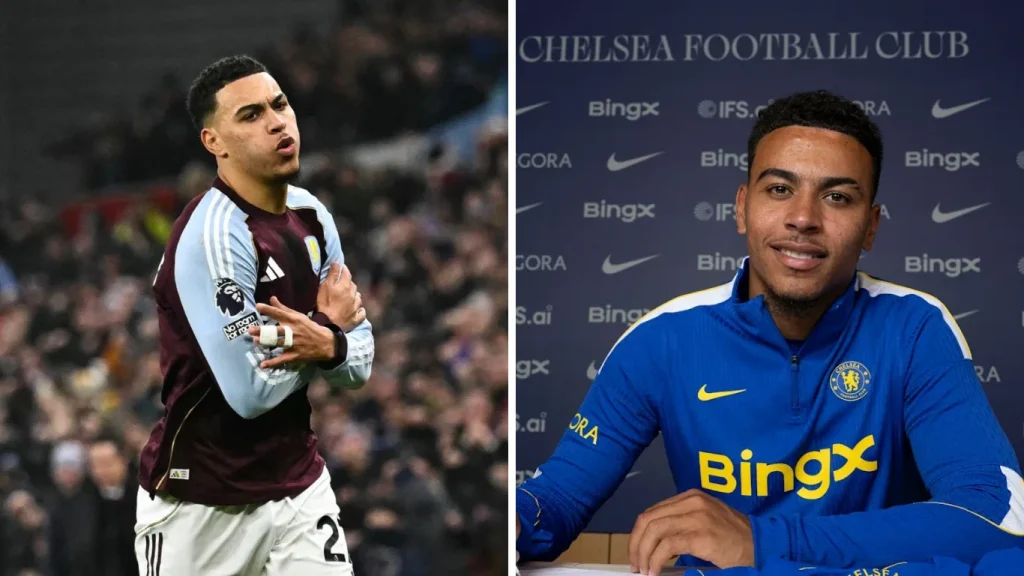
Chelsea’s £117 million signing of Morgan Rogers from Aston Villa made him the most expensive British player in history, and it is the kind of fee that demands a proper look at exactly what the club is getting.
Rogers arrives as a 23 year old England international who spent last season redefining what a modern Aston Villa forward could look like, operating across the left, the right, through the middle as a false nine and, at times, dropping deeper still.
He has signed a contract at Stamford Bridge running until 2033, and he says Xabi Alonso’s footballing philosophy, along with a recruitment push from his close friend Cole Palmer, was decisive in choosing Chelsea over other suitors.
This report is being written now because Rogers is about to walk into a genuinely open competition for one of the most contested spots in Alonso’s team, the left inside channel most recently occupied by Enzo Fernandez.
Understanding his game, the half-space running, the two-footed dribbling, the shooting range and the defensive question marks, is the only way to judge whether that £117 million fee was spent on a luxury or on a player who solves a real tactical problem.

Morgan Rogers’ Playing Style Overview
Rogers is one of the more difficult modern forwards to pin down positionally, and that is by design rather than accident.
At Villa he was used as a left winger, a right winger, a number ten and a false nine, and Chelsea are understood to see him the same way: a player capable of filling any of the four attacking positions outside of a central striker role, with the option to drop into a deeper midfield line when the game demands it.
What ties all of those positions together is a carrying game built on “no angle bias.”
Rogers is comfortable driving at defenders off either foot and from either flank, and he does not have a favoured direction the way most wide forwards do.
He uses feints to shift a defender’s body weight one way before going the other, and he is just as likely to cut inside from the left as he is to run the outside from the right.
Combine that with genuine power and long striding acceleration, and Villa consistently found joy simply getting the ball to his feet in space and letting him work.
The trade-off is volume. Rogers touches the ball more than almost any other Premier League forward in dangerous, high-turnover areas, which is precisely why the numbers on how often he loses it look alarming out of context.
It is a symptom of usage, not evidence that the underlying skillset is flawed, and the strengths below explain why Villa built so much of their attack around giving him exactly that kind of responsibility.

Morgan Rogers’ Strengths
A Free Spirit Who Plays With No Angle Bias
The half-space is where Rogers does his most damaging work, and he attacks it from both sides of the pitch with equal conviction.
He has the strides, the power and the athleticism to create genuine separation from a defender in a straight sprint, but it is the feints that make him so hard to set against.
He will load his body weight to suggest one direction and break the other way, on either foot, and defenders who over-commit to cutting off his stronger side are routinely punished for it.
That two-footed quality means there is no reliable way to show him onto a “safe” foot, which is normally the first thing a defensive coach tries to do against a wide forward.
It is not just about beating a man in isolation either.
Rogers’ half-space runs consistently drag a second defender out of position, opening lanes for a runner from midfield or a winger arriving from the opposite side.
He supersedes a lot of conventional structure simply because his profile, power, both-footed technique and total lack of directional predictability, does not fit the usual toolkit teams prepare for a winger or a number ten.
Elite Ball-Carrying and Contact-Absorbing Dribbling
Rogers was one of the most productive dribblers in the Premier League for Villa last season, and the mechanics behind that are as impressive as the output.
He mixes small, quick touches to change his angle of approach and manipulate a defender with larger touches designed purely to eat up ground and attack space in behind, and he uses that variety to skip inside defenders, nutmeg them, or chop back against their own momentum.
What sets him apart physically is what happens when contact actually arrives.
Rogers has an unusual ability to bundle through challenges, using his frame and his arms to shield the ball while somehow gaining momentum through the collision rather than losing it, a quality that very few dribblers in the league possess to the same degree.
He is also particularly good at taking touches across a defender, especially cutting in from the left, to kill the defender’s momentum stone dead and open a shooting or passing lane that was not there a second earlier.
Progressive Passing and Long-Range Shooting
The idea that Rogers is a pure carrier who does not contribute to the passing game does not survive contact with the data.
According to Opta, Rogers ranked first or second among Premier League forwards in 2025-26 for progressive passes (132), passes ending in the final third (529), line-breaking passes (100), line-breaking passes in the final third (82) and line-breaking passes leading directly to a goal (5).
He also created 13 big chances and scored three goals from outside the box, numbers that put him among the most productive attacking creators in the division regardless of position.
1-2 – Morgan Rogers ranked first or second among forwards in the Premier League in 2025-26 for:
Progressive Passes (132)
Passes ending in the final third (529)
Line-breaking passes (100)
Line-Breaking Passes in the final third (82)
Line-Breaking Passes leading to a goal (5)
Big… https://t.co/vr289raSck pic.twitter.com/2tgqAijF9U— OptaJoe (@OptaJoe) July 22, 2026
His shooting is the other half of that record. Rogers strikes the ball with real venom and dip from both feet, with enough variety in his finishing that defensive lines have to respect his range from almost anywhere within sight of the box.
Whether that means jumping out to close him down and risking space in behind, or sitting off and accepting the shot, which Rogers punished repeatedly last season.
There is a still largely untapped instinct inside the box too, with several goals last season coming from darts across the near post, suggesting the physical tools to arrive, absorb contact and finish are there for Chelsea to develop further.
Morgan Rogers’ Weaknesses and Areas for Development
The most cited number against Rogers is also the most misunderstood. According to WhoScored, he was dispossessed more (80 times) and recorded more unsuccessful touches (133) than any other player in the Premier League this season.
Morgan Rogers has been dispossessed (80) and recorded more unsuccessful touches (133) than any other Premier League player this season. 😬 pic.twitter.com/L11wLHrkTI
— WhoScored (@WhoScored) July 24, 2026
Those figures are real and worth taking seriously, but they are also a direct consequence of how much of Villa’s attacking play ran through him in areas where the ball is naturally live and contested.
A player who carries as often and as centrally as Rogers does will always show up near the top of these charts. The more legitimate concern sits in the fine detail around the box, where his own tendency to become fixated on completing a carry or manufacturing his own shot can narrow his vision and cost Villa a cleaner final pass to a better-placed teammate.
Defensively, Rogers is not a player Chelsea should expect to use as a primary presser or ball-winner.
Across 28 Aston Villa appearances in 2025-26 he registered 25 tackles and 4 interceptions, with a tackles per 90 figure that sits in only the 29th percentile among his positional peers and a combined tackles-and-interceptions number in the 26th percentile.
His 40.9 percent success rate against dribblers is functional rather than impressive.
What the underlying data does suggest is intelligent positioning over aggressive pressing, Rogers keeps himself available to receive after Villa win the ball back rather than being the one who wins it, which is a reasonable division of labour in the right system but one Alonso will need to build around rather than rely on.

Morgan Rogers’ Physical and Defensive Profile
Rogers’ physical profile is arguably as central to Chelsea’s interest as anything he does technically.
His combination of power, long striding acceleration and sheer athleticism is what allows the half-space running and the contact-absorbing dribbling to function at Premier League speed, and reports around the move have made clear that Chelsea and Alonso specifically value his size and physicality as attributes the squad was short of.
That unusual quality of gaining momentum through a tackle rather than being knocked off the ball is a genuine physical outlier, and it is a big part of why defenders who get a hand on him so rarely come away with the ball.
The defensive side of that physical profile is more measured than his attacking output would suggest. Rogers is not a high-press specialist and the underlying numbers, modest tackle and interception rates, a below-average ball recovery figure, back that up clearly.
He is disciplined in his positioning across the width of the pitch rather than chasing the ball, which keeps him fresh for the moment Villa, and now Chelsea, actually win it back.
It is a profile built for transition and progression, not for leading a defensive press, and any tactical plan around him needs to account for that honestly rather than assume he will offer more defensively than he has shown so far.
Does Morgan Rogers Fit Tactically at Chelsea?
Whatever formation Alonso ultimately settles on, Rogers looks set to spend a significant amount of time in the left inside channel, the same zone Enzo Fernandez occupied most often last season.
That overlap is the single biggest tactical question his arrival raises, and it will likely push Fernandez either into a deeper midfield role or into rotation, rather than simply displacing him outright given Rogers’ own comfort operating across four different attacking positions plus false nine.
Where Rogers should add something Chelsea did not clearly have before is his long-range shooting threat. Sides that sit deep and compact against Chelsea have historically been able to limit central penetration, and a player who is genuinely dangerous shooting from range within sight of the box gives Alonso another way to break down a low block without needing to force a pass through a crowded final third.
His two-footed half-space running also complements Cole Palmer’s own game rather than duplicating it, and the pair’s existing relationship, reportedly a factor in Rogers choosing Chelsea in the first place, should help their combination play develop faster than a typical new-signing pairing.
Off the pitch, Chelsea are said to rate Rogers’ attitude as highly as his football. He is regarded as humble, without ego, and seen as someone who will fit easily into the existing dressing room, which matters given how much of Alonso’s rebuild has leaned on squad culture as well as talent.
Morgan Rogers to Chelsea: Verdict
Morgan Rogers is not a conventional wide forward, and trying to judge him against a conventional wide forward’s checklist misses the point of the signing.
The two-footed half-space running, the contact-absorbing carrying, the record-setting progressive passing numbers and the genuine shooting range from distance combine into a profile that, at its best, is genuinely difficult to coach against because it does not follow a predictable pattern.
The £117 million fee will always invite scrutiny, and the weaknesses are real rather than cosmetic: the turnover numbers, however explained by volume, need to come down, and he will not solve Chelsea’s pressing or defensive transition issues on his own.
But as a gamebreaking, tactics-superseding attacking profile that fits Xabi Alonso’s stated priorities of physicality, versatility and end product, Rogers gives Chelsea something the squad did not previously possess.
Whether that is worth a British transfer record depends on how quickly he adapts, but the underlying tools to justify it are clearly there.
FAQs
What position does Morgan Rogers play for Chelsea?
Rogers is a versatile attacker capable of playing left wing, right wing, as a number ten or as a false nine, and he is expected to spend significant time in the left inside channel under Xabi Alonso.
How much did Chelsea pay for Morgan Rogers?
Chelsea signed Rogers from Aston Villa for £117 million, making him the most expensive British player in football history. He has signed a contract until 2033.
Is Morgan Rogers good defensively?
Not by volume. Across 28 Aston Villa appearances in 2025-26 he recorded 25 tackles and 4 interceptions, with tackle and recovery numbers in the bottom third among positional peers, reflecting a positionally disciplined but low-press defensive profile.
What are Morgan Rogers’ main strengths?
His half-space running on both sides of the pitch, two-footed contact-absorbing dribbling, elite progressive passing numbers and long-range shooting are the standout traits in his game.